5052 H32 vs 6061 T6 Aluminum: What’s the Difference?
Choosing the right aluminum alloy can significantly impact your product’s performance, manufacturing efficiency, and overall cost. Among the most widely used aluminum grades, 5052 H32 vs 6061 T6 Aluminum are frequently compared because both offer excellent strength-to-weight ratios, Te mau mana'o tauturu no te haapiiraa, and versatility across multiple industries.
Tera râ,, these two alloys are designed for different purposes.
5052 H32 is a non-heat-treatable aluminum alloy known for its outstanding corrosion resistance, excellent formability, and superior weldability.
It is commonly used in marine equipment, sheet metal fabrication, fuel tanks, pressure vessels, and electronic enclosures.
6061 T6, on the other hand, is a heat-treated structural aluminum alloy valued for its high strength, excellent machinability, and dimensional stability.
It is widely used in CNC machining, structural frames, aerospace fixtures, industrial automation, and transportation equipment.
No reira, which alloy is better?
The answer depends on your application rather than a single material property.
If your project involves extensive bending, welding, or exposure to seawater, 5052 H32 is usually the preferred option.
If you need higher structural strength, precision machining, or load-bearing performance, 6061 T6 is generally the better choice.
In this guide, we’ll compare the two alloys across every critical engineering factor—including mechanical properties, Te mau mana'o tauturu no te haapiiraa, machinability, weldability, cost, and real-world applications—to help engineers, buyers, and manufacturers make an informed decision.
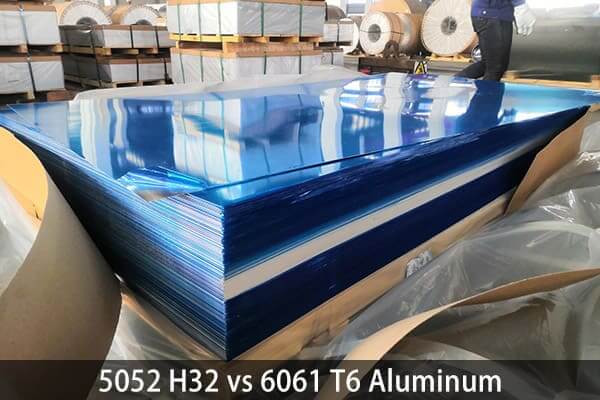 5052 H32 vs 6061 T6 Aluminum
Quick Comparison: 5052 H32 vs 6061 T6 Aluminum
| Property |
5052 H32 |
6061 T6 |
| Alloy Series |
5xxx Aluminum |
6xxx Aluminum |
| Main Alloying Elements |
Magnesium |
Magnesium + Silicon |
| Heat Treatable |
No |
Yes |
| Strength |
Medium |
High |
| Hardness |
Medium |
High |
| Corrosion Resistance |
Excellent |
Very Good |
| Marine Performance |
Excellent |
Good |
| Weldability |
Excellent |
Good |
| Machinability |
Fair |
Excellent |
| Formability |
Excellent |
Good |
| CNC Performance |
Fair |
Excellent |
| Sheet Metal Fabrication |
Excellent |
Good |
| Structural Applications |
Moderate |
Excellent |
| Typical Products |
Sheet & Plate |
Plate, Bar & Extrusions |
At a Glance
Choose 5052 H32 if you need:
- Excellent corrosion resistance
- Marine applications
- Sheet metal fabrication
- Tight-radius bending
- Superior weldability
- Lightweight enclosures
Choose 6061 T6 if you need:
- High structural strength
- CNC machining
- Precision components
- Extruded profiles
- Industrial equipment
- Load-bearing structures
Understanding the Difference Between 5052 H32 and 6061 T6
Although both materials are aluminum alloys, they belong to different alloy families and achieve their mechanical properties through entirely different strengthening mechanisms.
This distinction explains why they behave differently during machining, welding, bending, and long-term service.
What Is 5052 H32 Aluminum?
5052 H32 belongs to the 5000 anairaa aluminum alloys, where magnesium is the primary alloying element.
Unlike heat-treatable aluminum grades, 5052 gains strength through strain hardening (cold working) rather than heat treatment.
The H32 temper indicates that the alloy has been:
- Strain hardened
- Stabilized through low-temperature treatment
- Processed to achieve a balance between strength and ductility
This combination provides several practical advantages:
- Outstanding resistance to seawater corrosion
- Excellent resistance to industrial chemicals
- Superior bending performance
- Easy welding with minimal loss of corrosion resistance
- Good fatigue performance under cyclic loading
Because of these characteristics, 5052 H32 is one of the most commonly specified alloys for sheet metal fabrication.
For manufacturers working with laser cutting, punching, bending, and welding, 5052 often provides lower fabrication costs because it is easier to form without cracking.
 5052 H32 for Boat Hull Construction
What Is 6061 T6 Aluminum?
6061 belongs to the 6000 anairaa aluminum alloys, where magnesium and silicon combine to form magnesium silicide (Mg₂Si), enabling the alloy to respond to heat treatment.
Ua haapii mai te T6 temper is produced through a two-step process:
- Solution heat treatment
- Artificial aging
This heat treatment significantly increases hardness, tensile strength, and yield strength while maintaining good corrosion resistance.
Compared with 5052, 6061 T6 offers:
- Higher mechanical strength
- Better rigidity
- Improved dimensional stability
- Excellent machinability
- Better surface finish after CNC machining
These characteristics make 6061 one of the world’s most widely used engineering aluminum alloys.
When strength and machining efficiency are more important than formability, 6061 is generally the preferred material.
Why Are 5052 H32 and 6061 T6 So Different?
Many buyers assume that all aluminum alloys behave similarly because they share the same base metal.
In reality, the alloying elements and strengthening methods have a significant impact on performance.
5052 H32: Strength Through Cold Working
5052 contains approximately 2.5% magnesium, which improves corrosion resistance while allowing the alloy to be strengthened by cold working.
Since it is not heat treatable, its strength remains relatively stable after welding, making it a reliable choice for fabricated assemblies.
This is also why 5052 maintains excellent ductility, allowing it to withstand tight-radius bending and deep drawing operations without cracking.
6061 T6: Strength Through Heat Treatment
6061 contains both magnesium and silicon, forming magnesium silicide precipitates during artificial aging.
These microscopic precipitates significantly increase strength and hardness.
Tera râ,, the heat treatment also reduces ductility, making 6061 more susceptible to cracking during aggressive forming operations.
Additionally, welding locally destroys the T6 temper in the heat-affected zone, reducing strength unless post-weld heat treatment is performed.
Understanding these metallurgical differences helps explain why 5052 excels in fabrication while 6061 dominates structural and machined applications.
What Does H32 Mean?
Many purchasing managers recognize the alloy number but overlook the temper designation, even though it can dramatically affect material performance.
For 5052 H32:
- H indicates the material has been strain hardened rather than heat treated.
- 3 means the alloy has been stabilized after cold working to improve dimensional stability.
- 2 indicates the material has reached approximately one-quarter of the maximum strain-hardened condition.
The result is an alloy that balances strength, flexibility, and corrosion resistance, making it ideal for applications requiring forming and welding.
What Does T6 Mean?
The temper designation is equally important for 6061.
For 6061 T6:
- T identifies a heat-treated alloy.
- 6 means the material has been solution heat treated and artificially aged.
This process creates a fine distribution of strengthening precipitates throughout the aluminum matrix, giving 6061 its characteristic high strength and excellent machining performance.
The trade-off is reduced ductility compared with 5052 H32, which should be considered when designing parts that require significant bending or forming.
Key Takeaways
Before comparing specific mechanical properties, it’s important to understand that 5052 H32 and 6061 T6 are engineered for different manufacturing priorities.
- 5052 H32 is optimized for corrosion resistance, sheet metal fabrication, and welded structures.
- 6061 T6 is optimized for structural strength, machining precision, and load-bearing performance.
 6061 T6 Aluminum for Structure
Chemical Composition Comparison
Although both alloys are aluminum-based, their alloying elements are fundamentally different.
These differences determine their strength, Te mau mana'o tauturu no te haapiiraa, weldability, and manufacturing performance.
| Element |
5052 H32 |
6061 T6 |
| Aluminum (Al) |
Balance |
Balance |
| Magnesium (Mg) |
2.2–2.8% |
0.8–1.2% |
| Silicon (Si) |
Max 0.25% |
0.4–0.8% |
| Copper (Cu) |
Max 0.10% |
0.15–0.40% |
| Chromium (Cr) |
0.15–0.35% |
0.04–0.35% |
| Iron (Fe) |
Max 0.40% |
Max 0.70% |
| Zinc (Zn) |
Max 0.10% |
Max 0.25% |
The most significant difference is the alloying system.
5052 relies primarily on magnesium, which improves corrosion resistance and increases strength through strain hardening.
6061, by contrast, contains both magnesium and silicon, allowing it to form magnesium silicide during heat treatment. These microscopic precipitates are responsible for the alloy’s much higher strength and hardness.
From an engineering perspective, this means:
- 5052 is optimized for fabrication and corrosion resistance.
- 6061 is optimized for structural performance and machining.
Mechanical Properties Comparison
Mechanical properties are often the deciding factor when selecting an aluminum alloy.
Tera râ,, strength alone should not determine your choice. Properties such as ductility, fatigue resistance, and stiffness also influence how a part performs in service.
| Property |
5052 H32 |
6061 T6 |
| Density |
2.68 g/cm³ |
2.70 g/cm³ |
| Te puai no te ti'araa p |
228 MPa |
310 MPa |
| Yield Strength |
193 MPa |
276 MPa |
| Te mana'o hape |
12–18% |
8–12% |
| Brinell Hardness |
60 HB |
95 HB |
| Elastic Modulus |
70 GPa |
69 GPa |
At first glance, 6061 appears superior because of its significantly higher tensile and yield strength.
Tera râ,, the higher elongation of 5052 means it can absorb more deformation before failure.
This makes it particularly suitable for components that undergo bending, stamping, or repeated forming operations.
The elastic modulus of both alloys is nearly identical, meaning they have similar stiffness under elastic loading. The main difference lies in their strength and ductility.
Strength Comparison
Which Alloy Is Stronger?
When comparing strength, 6061 T6 is the clear winner.
Its tensile strength is approximately 35% higher than 5052 H32, while its yield strength is more than 40% higher.
This allows engineers to design lighter structural components without sacrificing load-bearing capacity.
Typical examples include:
- Machine frames
- Automation equipment
- Aerospace fixtures
- Robot arms
- Structural supports
- Transportation equipment
Higher strength also improves resistance to permanent deformation under heavy loads.
Tera râ,, stronger does not always mean better.
For sheet metal products, excessive strength may actually make fabrication more difficult because harder materials require greater bending force and are more likely to crack during forming.
Why Doesn’t Everyone Use 6061?
This is one of the most common misconceptions among buyers.
Many assume that choosing the strongest alloy automatically results in the best product.
In reality, material selection always involves trade-offs.
Ei hi'oraa, a marine enclosure exposed to saltwater rarely requires extremely high strength.
Instead, Te mau mana'o tauturu no te haapiiraa, weldability, and ease of fabrication become far more important.
In this situation, 5052 H32 often delivers better long-term performance despite its lower strength.
Corrosion Resistance
Corrosion resistance is one of the biggest advantages of 5052 H32.
Because magnesium is the primary alloying element, 5052 naturally forms a highly protective oxide layer that performs exceptionally well in harsh environments.
It offers excellent resistance to:
- Saltwater
- Marine atmospheres
- Industrial pollution
- Humid climates
- Mild alkaline environments
For this reason, 5052 has long been the preferred material for marine fabrication.
Typical applications include:
- Boat hulls
- Dock equipment
- Fuel tanks
- Offshore platforms
- Coastal architectural panels
How Does 6061 Perform?
6061 also provides good corrosion resistance in most outdoor environments.
Tera râ,, compared with 5052, it is more susceptible to:
- Pitting corrosion
- Crevice corrosion
- Galvanic corrosion when paired with dissimilar metals
In coastal environments, many manufacturers recommend anodizing or applying protective coatings to improve durability.
If corrosion is the primary design concern, 5052 remains the safer choice.
Weldability Comparison
Both alloys can be welded using common aluminum welding methods such as TIG and MIG.
Tera râ,, their behavior after welding differs significantly.
Welding 5052 H32
5052 is one of the easiest aluminum alloys to weld.
Advantages include:
- Excellent weld quality
- Minimal cracking
- Good corrosion resistance after welding
- No heat treatment required
Because it is not heat treatable, welding does not dramatically change its mechanical properties.
This makes fabrication simpler and more economical.
Welding 6061 T6
6061 is also weldable, but there is an important consideration.
During welding, the heat-affected zone loses much of the T6 temper.
As a result:
- Strength near the weld decreases.
- Additional reinforcement may be required.
- Post-weld heat treatment may be necessary for critical structural applications.
This is one reason why welded marine structures are often manufactured from 5052 rather than 6061.
Machinability Comparison
Machinability is where 6061 T6 truly stands out.
Its higher hardness allows cutting tools to produce cleaner chips, smoother surfaces, and tighter tolerances.
Benefits include:
- Faster machining speeds
- Better chip evacuation
- Reduced tool wear
- Higher dimensional accuracy
- Superior surface finish
For CNC manufacturers, these advantages translate directly into lower production costs.
Machining 5052
Noa'tu e 5052 can certainly be machined, it behaves differently.
Its softer material tends to produce long, gummy chips.
This can lead to:
- Increased tool wear
- More frequent chip removal
- Lower cutting speeds
- Reduced surface quality
Consequently, 5052 is typically chosen for fabricated sheet metal parts rather than precision-machined components.
Formability Comparison
One of the biggest advantages of 5052 H32 is its excellent formability.
Compared with 6061, it can withstand much tighter bend radii without cracking.
This makes it ideal for:
- Deep drawing
- Roll forming
- Press braking
- Sheet metal bending
- Complex enclosures
Manufacturers often prefer 5052 when producing parts with multiple bends because it reduces scrap rates and improves production efficiency.
Can 6061 Be Bent?
Yes—but with limitations.
6061 T6 has relatively low ductility.
Sharp bends can create surface cracks, especially in thicker sections.
When significant forming is required, manufacturers may choose:
- 6061-O (annealed condition) for bending, followed by heat treatment if applicable.
- 5052 H32 to avoid additional processing.
As a general rule:
If your design includes multiple bends or tight inside radii, 5052 H32 is usually the safer and more economical choice.
Cost Comparison: Is 5052 e aore râ, 6061 More Cost-Effective?
When comparing aluminum alloys, many buyers focus only on the price per kilogram.
Tera râ,, for most manufacturing projects, the total production cost is far more important than the raw material price.
Material cost is only one part of the equation. Machining time, fabrication efficiency, welding requirements, scrap rate, and maintenance can all have a greater impact on the final cost of a component.
Raw Material Cost
In most global markets, 5052 aluminum sheet is often slightly less expensive than 6061 plate, especially for sheet products. Tera râ,, the price difference is usually modest and can fluctuate depending on:
- Aluminum market prices
- Me'ume'u
- Product form (sheet, plate, bar, extrusion)
- Order quantity
- Supplier location
For large-volume projects, even a small price difference can affect the overall budget.
Manufacturing Cost
Manufacturing costs often outweigh raw material costs.
| Cost Factor |
5052 H32 |
6061 T6 |
| Material Price |
Lower |
Slightly Higher |
| CNC Machining |
Higher |
Lower |
| Bending |
Lower |
Higher |
| Welding |
Lower |
Higher |
| Tool Wear |
Higher |
Lower |
| Scrap Rate |
Lower |
Higher (for complex bends) |
| Fabrication Efficiency |
Excellent |
Good |
Ei hi'oraa:
A sheet metal enclosure requiring laser cutting, multiple bends, and welding is generally more economical when manufactured from 5052 H32.
Conversely, a precision-machined structural bracket may cost less overall when made from 6061 T6, because faster machining offsets the higher material price.
Which Alloy Offers Better Value?
There is no universal answer.
- If fabrication is the primary process, 5052 H32 usually provides better value.
- If CNC machining dominates production, 6061 T6 often results in lower total manufacturing costs.
The best choice depends on the complete manufacturing workflow rather than the material price alone.
Typical Applications of 5052 H32 vs 6061 T6 Aluminum
Both alloys are widely used across different industries, but they serve different engineering purposes.
Common Applications of 5052 H32
5052 is primarily used where corrosion resistance and fabrication are critical.
Typical applications include:
- Marine hulls
- Boat decks
- Fuel tanks
- Pressure vessels
- Electronic enclosures
- HVAC ductwork
- Truck body panels
- Food processing equipment
- Architectural cladding
- Chemical storage tanks
Because it combines excellent corrosion resistance with outstanding formability, 5052 remains one of the most widely used sheet aluminum alloys.
Common Applications of 6061 T6
6061 is preferred when higher strength and machining performance are required.
Typical applications include:
- CNC machined parts
- Machine frames
- Industrial automation
- Robotics
- Aerospace fixtures
- Automotive components
- Bicycle frames
- Structural supports
- Conveyor systems
- Precision tooling
Its versatility has made 6061 one of the world’s most commonly specified engineering aluminum alloys.
Industry Comparison
The table below provides a quick overview of which alloy is generally recommended for different industries.
| Industry |
Recommended Alloy |
Primary Reason |
| Marine |
⭐5052 |
Excellent seawater corrosion resistance |
| Shipbuilding |
⭐5052 |
Better welding performance |
| Aerospace Fixtures |
⭐6061 |
Higher strength |
| Automotive |
⭐6061 |
Structural performance |
| Electronics Enclosures |
⭐5052 |
Easy fabrication |
| HVAC |
⭐5052 |
Excellent bending |
| Industrial Automation |
⭐6061 |
Precision machining |
| Robotics |
⭐6061 |
High rigidity |
| Chemical Processing |
⭐5052 |
Te patoiraa i te patoiraa |
| Food Equipment |
⭐5052 |
Hygienic and corrosion resistant |
As a general rule, industries that rely heavily on sheet metal fabrication tend to favor 5052, while industries requiring precision-machined structural parts usually prefer 6061.
Common Mistakes When Choosing 5052 H32 vs 6061 T6 Aluminum
Choosing the wrong aluminum alloy can increase production costs, reduce product lifespan, or complicate manufacturing. Below are some of the most common mistakes engineers and buyers make.
1: Assuming Higher Strength Is Always Better
Many first-time buyers automatically choose 6061 because its mechanical strength is higher.
Tera râ,, if the component primarily requires bending, welding, or corrosion resistance, the additional strength may provide little practical benefit.
Instead, it can increase fabrication difficulty and production costs.
2: Ignoring the Manufacturing Process
Material selection should always consider how the part will be manufactured.
Ei hi'oraa:
- CNC machining → 6061
- Laser cutting → Either
- Complex bending → 5052
- Deep drawing → 5052
- Structural machining → 6061
The manufacturing process often determines the most suitable alloy.
3: Overlooking the Service Environment
Outdoor and marine applications require more than mechanical strength.
Saltwater, humidity, chemicals, and UV exposure all influence long-term durability.
In many coastal projects, 5052 provides a longer service life with less maintenance.
4: Forgetting About Welding Effects
6061 loses strength in the heat-affected zone during welding.
If the welded area will experience high structural loads, additional reinforcement or post-weld heat treatment may be required.
5052 generally retains more consistent properties after welding.
How to Choose Between 5052 H32 and 6061 T6
The easiest way to select the right alloy is to begin with your manufacturing requirements.
Choose 5052 H32 If You Need:
✔ Marine applications
✔ Saltwater resistance
✔ Fuel tanks
✔ Sheet metal fabrication
✔ Multiple bending operations
✔ Excellent weldability
✔ Chemical resistance
✔ Outdoor enclosures
Choose 6061 T6 If You Need:
✔ High structural strength
✔ CNC machining
✔ Precision components
✔ Industrial automation
✔ Machine frames
✔ Extruded profiles
✔ High rigidity
✔ Mechanical load-bearing capacity
Quick Decision Matrix
| Requirement |
Best Choice |
| Highest Strength |
⭐6061 |
| Best Corrosion Resistance |
⭐5052 |
| Best Weldability |
⭐5052 |
| Best Machinability |
⭐6061 |
| Best Formability |
⭐5052 |
| Marine Environment |
⭐5052 |
| CNC Machining |
⭐6061 |
| Structural Components |
⭐6061 |
| Sheet Metal Fabrication |
⭐5052 |
| Overall Versatility |
Depends on Application |
Expert Selection Tips
Before specifying an aluminum alloy, ask yourself these questions:
- Will the part be machined or fabricated?
- Is Te mau mana'o tauturu no te haapiiraa more important than maximum strength?
- Does the design include tight-radius bends?
- Will the component be welded?
- Is the product intended for marine or coastal environments?
- Which factor has the greatest impact on cost: machining time or fabrication time?
By answering these questions first, you can usually identify the most suitable alloy before comparing detailed specifications.